The Estate Sale
On a spring afternoon, Reshel and I drove out to our first estate sale. She'd been scanning the local listings online and noticed an ad that mentioned books. Up until that day, we'd been picking up small lots through Facebook Marketplace and weekend garage sales — ten or twenty books at a time, slowly building a modest fifty-to-a-hundred-volume inventory. We didn't quite know what we were driving toward.
When we walked in, we couldn't believe our eyes. Wall-to-wall bookshelves — antique and vintage hardcovers in green and red cloth, mid-century paperbacks stacked into towers, reference volumes that hadn't been opened in decades, and a few pieces that looked like they belonged behind glass.
We looked at each other and went straight for the closest shelf. We felt like two kids in a candy store. First things first: we pulled the oldest-looking volume, took a picture with the phone, and ran it through Google. Vintage 1943 hardcover, $50 to $150. Yep, just what we thought.
It was obvious to us — as book prospectors, we'd hit a gold mine of books.
We lost track of time. Three or four hours went by — pulling, photographing, working one shelf at a time — and we still hadn't covered a fraction of what was there. The deceased owner had clearly been a collector. As the afternoon ran out, Reshel and I stepped aside and talked it through privately. Could we really do this? We came back inside, made an offer for the whole collection, and it was accepted.
At that very moment, it became a calculated business decision — we committed ourselves. What was sitting on those shelves was something rare. Not just rare books individually, but a rare opportunity to do something with all of it together. That was Phase I. Phase II came the next day: returning, loading box after box into the truck. By the time we hauled the last one out, we'd already begun our journey into the used-book industry.
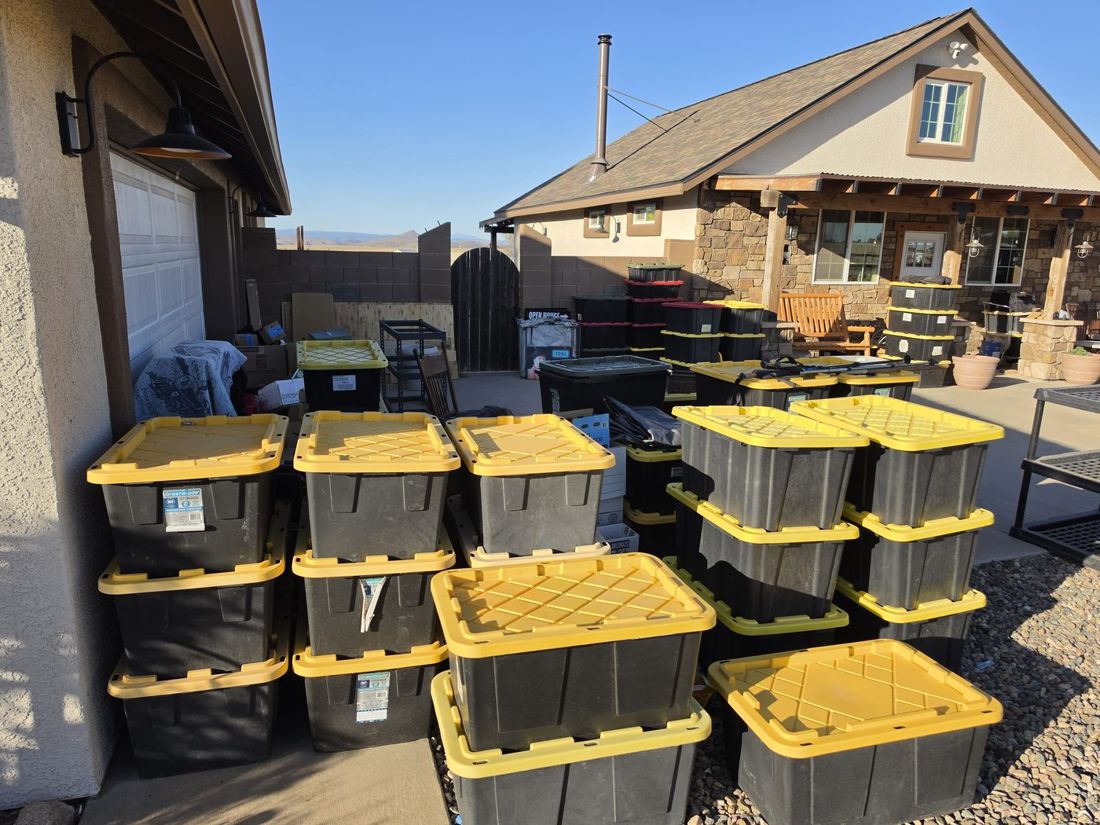
The Garage in Prescott
BriteBound Books LLC is run out of a garage in Prescott, Arizona — cleared out, swept clean, and lined floor-to-ceiling with industrial shelving. Every book that comes in is unpacked, inspected, photographed, and catalogued here before it ever goes up for sale. There's no warehouse, no offshore fulfillment, no algorithm deciding what to list. There's Reshel and me, the shelves, and a long-running spreadsheet that's becoming a catalog of what we've found.
How We Work
Every book listed on this site has been personally handled. We open the front cover and look at the endpapers — for inscriptions, gift dedications, library stamps, prior-owner names penciled in script. We turn to the title page to confirm the publisher and edition. We check the copyright page for the printing line, the year, the little details that separate a true first edition from a later reprint. We feel the binding to know whether the book is sound or sprung. We notice the dust jacket if there is one — whether it's the original, whether it's price-clipped, whether it's been protected by mylar by some earlier careful owner.
We describe what we find honestly. Condition is what it is. We don't grade up to move a book faster. If a copy has foxing, we say foxing. If the spine is rolled, we say rolled. If a book has been read — really read, with margin notes and a coffee stain on page 142 — we mention the coffee stain too, because sometimes that's exactly what makes the copy interesting.
The Stories Inside the Stories
Books that have been on shelves for fifty or a hundred years carry things in them. Bookmarks left at chapter breaks. Pressed flowers between pages. Old postcards. Letters never mailed. Newspaper clippings tucked in by readers who meant to come back to them. Local cookbooks with handwritten recipes passed down from one generation to the next.
Earlier this year we opened a copy of Janice Meredith: A Story of the Revolution — a Paul Leicester Ford novel from 1899 — and found two Cleveland newspaper clippings dated Tuesday, October 21, 1913 still tucked inside. One was a civic-affairs article about the steamer City of Erie; the other was a syndicated educational column titled "The Foundation of a New Nation: Independence." Whoever was reading the novel was studying American history alongside it, the clipping as a companion to the story. They stopped reading at the end of Chapter XXXVIII and never came back. The clippings stayed where they were placed for the next 113 years. The front endpaper carries a 2004 donation inscription to the Prescott chapter of the Daughters of the American Revolution — the General George Crook Chapter, named for the general who was stationed at Fort Whipple just outside this very town.
A book like that has lived three lives across three American anniversaries. That's the kind of story we look for.
What's Ahead
We're cataloging through summer 2026 with the 250th anniversary of the United States in mind. A meaningful share of what's still on our shelves is Americana — Revolutionary War history, colonial-era novels, founders' biographies, regional Western Americana. Some of it has been waiting for the right anniversary to find its next reader. We hope to be the bridge.
Beyond July 4th, we'll keep doing what we started doing in that estate sale: walking the lines between rare and common, between scholarly and sentimental, between books that need a careful home and books that just need a bookshelf. We'll keep adding to the catalog as fast as our hands can sort the boxes.
Thanks for reading this far.
— Paul & Reshel Simari
Prescott, Arizona